
Context
On September 22-24, 2024, the United Nations (UN) Summit of the Future will build upon the Sustainable Development Goals (SDGs) and bring together world leaders to forge a new international consensus on how to improve the delivery of present commitments and safeguard the future. Leading up to the Summit, a Pact for the Future will be negotiated and endorsed by member states, in order to define how intergovernmental stakeholders will meet existing international commitments and take concrete steps to respond to emerging challenges and opportunities.
Background on the Compact on Women, Peace and Security and Humanitarian Action
The WPS-HA Compact was launched during the Generation Equality Forum in July 2021 as a multistakeholder and intergenerational movement for bold action on gender equality and to advance the leadership and protection of women in conflict and crisis. By becoming signatories to the Compact, member states, UN entities, regional organizations, private sector actors, and civil society – including women-led and youth organizations – NGOs, and academic institutions take concerted action to implement existing commitments on WPS and humanitarian action. Through joint action, the Compact expands investments, strengthens coordination across existing mechanisms, and promotes financing for and visibility for WPS and humanitarian action.
To date, the Compact has more than 200 signatories and in 2022, signatories spent close to one billion dollars reaching 22.1 million women and girls.
Advancing WPS and gender-responsive humanitarian action
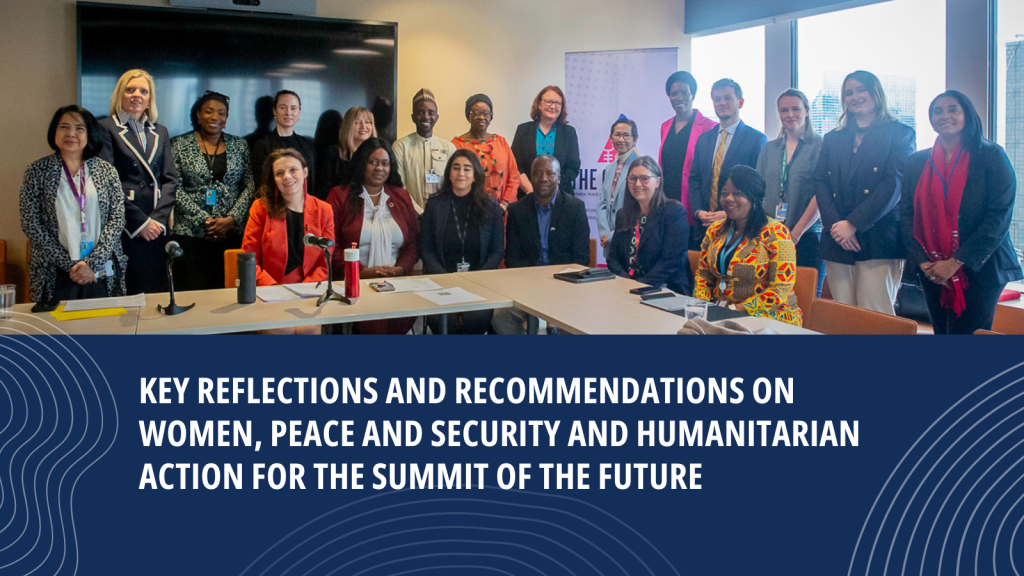
During the 68th session of the Commission on the Status of Women, the Compact held a symposium to identify key recommendations from UN member states to inform the Summit of the Future. The event, held on March 13-14, 2024, brought together signatories from member states, the UN, and civil society. The symposium included participation from Norway (co-chair of the Compact), Namibia and Germany (co-facilitators of the Summit of the Future) and Switzerland and Sierra Leone (co-chairs of the Security Council Informal Expert Group on WPS), as well as the African Union, Austria, Luxembourg, Romania, South Africa, United Kingdom, and the United Arab Emirates.
The discussions focused on practical ways to integrate WPS and gender-responsive humanitarian action into the Pact for the Future. Participants shared recommendations on leveraging the Pact to drive progress for the more than 600 million women and girls living in conflict and crisis settings today.
Key Recommendations Based on the Compact’s Principles of Transformation1
General recommendations
– Leverage the opportunity presented by the Pact for the Future to be even more ambitious and bold when it comes to advancing the WPS agenda and gender-responsive humanitarian action. Ensure that the Pact is action-oriented, includes concise language, and charts out specific actions that will make a transformative and positive difference to the lives of women and girls in conflict and crisis, rather than only stating intentions. There is currently no shortage of inspiration, particularly in the work led by civil society, but rather a lack of aspiration and ambition. However, civil society organizations need to be continuously supported and elevated through the engagement of member states as well as other policymakers and stakeholders who are not yet convinced of the importance of advancing the WPS agenda.
– Ahead of next year’s 25th anniversary of UN Security Council resolution 1325 on Women, Peace and Security, the Pact for the Future presents an opportunity to reinforce the role of women in peace and security by ensuring that the Pact has actionable recommendations and by mainstreaming gender equality and women’s rights into all sections of the Pact. It should highlight conflict and crisis prevention and reflect women’s leadership roles in peace processes and humanitarian action, as well as commitments that ensure the strengthening of women’s leadership and equal access to resources and decision-making positions.
Humanitarian-development-peace-nexus
– Recognize and support gender-responsive programming to achieve more effective humanitarian outcomes and increased investments, and systematize gender into the design and implementation of humanitarian response.
– Ensure that post-conflict reconstruction and recovery efforts address women’s context-specific and economic needs, including by incorporating gender-based violence prevention work, social norms change, and mental health services as an integrated part of economic recovery.
Localized, Intersectional, Intergenerational
– Recognize the context-specific nature of conflicts and their impact on local women and other marginalized groups, including their access to policy- and decision-making spaces.
– Address the pushback against LGBTQI rights and other marginalized groups and improve their access to protection mechanisms during conflicts and crises.
– Ensure accountability for crimes against women, including gender-based violence, conflict-related sexual violence, and other gender-based crimes.
– Improve the support to youth-led organizations who might not fulfill grant criteria related to size and income, recognize the work of young women peacebuilders, and ensure their protection and safety, including through the provision of mental health and self-care services.
Resourced and sustainable
– Seize the opportunity presented by the Pact to improve the financing for meaningful participation of women and the implementation of current WPS frameworks.
– Ensure that the Pact pushes for an increase in dedicated funding for women’s rights and women-led organizations working for peace through dedicated, flexible, and predictable funding, and lessen the administrative burden of grant applications so that women peacebuilders and first responders can focus on their implementing priorities.
– Reform multilateral institutions to ensure gender equality and regional representation to reflect the diversity of all nations, particularly on global issues such as WPS and climate change.
– Highlight that increased military spending is not leading to more peace and security, and the role of the WPS agenda in driving more inclusive and sustainable peace.
– Ensure that the Pact addresses specific funding opportunities and legislation that can be used to address emerging issues, including the risks of digital technology, especially for women human rights defenders and those in decision-making roles who often face higher risk of digital harassment and threats.
Inclusive and multistakeholder
– Ensure that the Pact is cross-sectoral by including language around engagement with the private sector, not only on funding but also on advocacy and program planning.
– Include specific measures to ensure the implementation of gender equality commitments across all thematic areas of the Pact, as well as the setting of targets to guarantee women’s meaningful participation and leadership in peace processes.
– Build on the recommendations of the UN Secretary-General’s report on WPS and its minimum target that one-third of participants in mediation and peace processes be women.
– Include actionable recommendations on the gender and climate nexus to ensure women’s leadership in climate and environmental action.
1 The Compact’s principles of transformation underscore the need to consider the interconnectedness of various factors and systems to achieve and promote sustainable change for women and girls in conflict and crisis.
/