
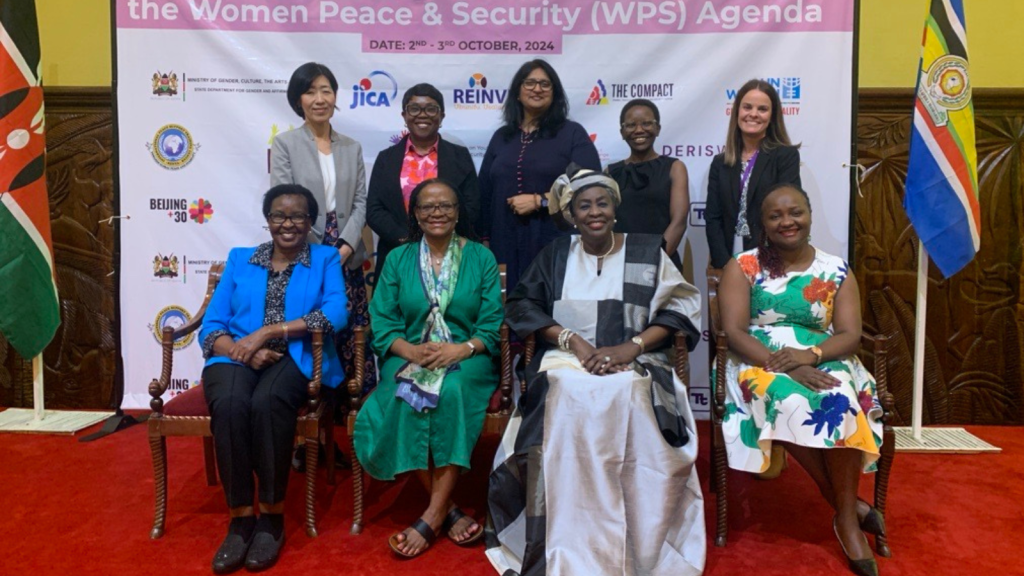
On October 3-4, 2023 the Compact on Women, Peace and Security and Humanitarian Action (WPS-HA Compact), the UN Women East and Southern Africa Regional Office, the Government of Kenya, Japan International Cooperation Agency (JICA), and Reinvent hosted a two-day regional symposium in Nairobi, Kenya to advance the implementation of the WPS agenda across the East and Southern Africa region and to identify high-impact priorities and partnerships to accelerate progress.
Women in the region have consistently played indispensable roles in preventing conflicts and fostering peace amidst numerous challenges on the African continent. Their vital role in peace processes – offering unique gender perspectives that enrich negotiations – as well as prevention, conflict resolution, and resilience efforts have significantly contributed to the implementation of UN Security Council Resolution 1325 on Women, Peace and Security.
The symposium was held against a backdrop of the evolving nature of peace and security threats in the Horn, East, and Southern Africa region. Factors impacting the peace and security landscape in the region include an increase in violent conflicts, political instability, terrorism and violent extremism, mass displacement, transnational and organized crime, climate change, and humanitarian emergencies – all of which have devastating consequences for women and girls.

The regional symposium aimed at taking stock of progress and identifying high-impact actions to accelerate progress towards the 25th anniversary of UN Security Council resolution 1325 and the 30th anniversary of the Beijing Declaration and Platform for Action in 2025. Participants included Member States, regional organizations civil society representatives including WPS-HA Compact signatories.
The symposium also served as a platform to share experiences on the implementation of Women, Peace and Security National Action Plans (NAPs) on WPS from East and Southern Africa and to highlight the Compact’s monitoring framework and principles of transformation. In addition, the two-day event aimed to create a forum for women to highlight the importance of their participation and representation in the prevention of conflict and conflict resolution, and to identify and inspire innovative methodologies to advance national implementation strategies and partnerships.
Ms. Jaki Mbogo, chairperson of NSC/WPS and the Chief of Party of the REINVENT Programme at Tetra Tech International Development kicked off the event with an overview of the regional symposium. Ms. Anne Mutavati, the UN Women Kenya Country Representative, gave opening remarks where she highlighted that “Member States need to chart a course for fostering peace and security in Kenya and across the Africa region.”
The symposium featured discussions on a wide range of timely issues, including the role of inclusive partnerships in the development and implementation of NAPs, regional mechanisms advancing the WPS agenda in the region, how to enhance accountability through monitoring and measuring of progress on NAPs, as well as the localization of the WPS agenda and the role of young women as catalysts for advancing peace and security in the region.
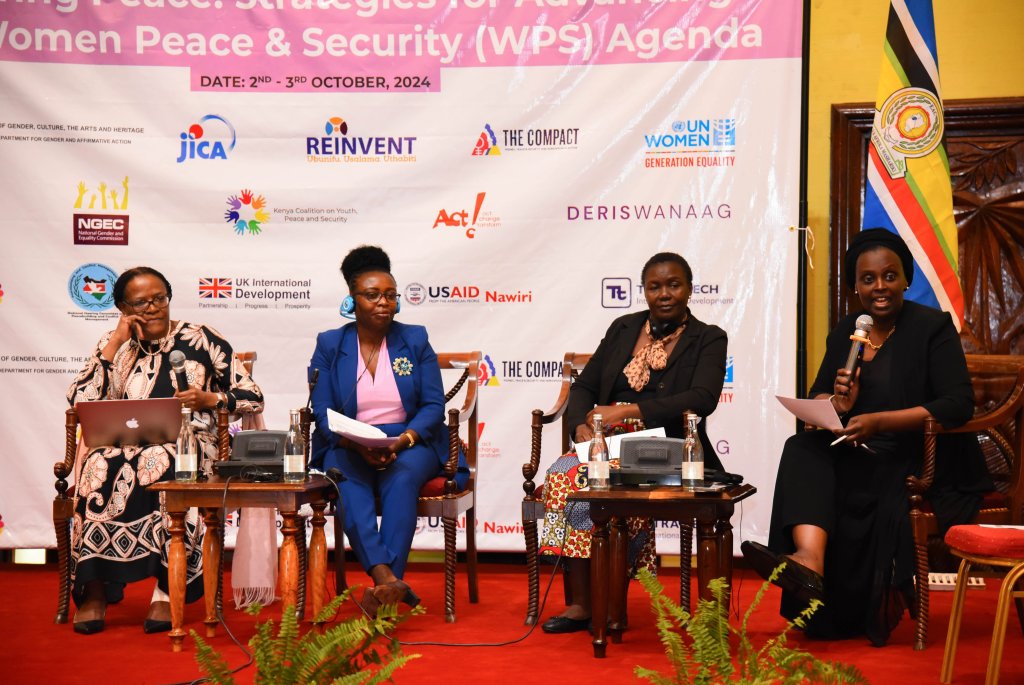
During an expert sharing session, Ms. Harriette Williams Bright, the WPS-HA Compact Lead, emphasized that the WPS-HA Compact has invested $958 million to implement and reached over 22.1 million women and girls in 2023.
“Countries and member states must redouble their efforts to address the WPS agenda. Currently, the number of armed conflicts is higher than ever post WWII and 612 million women and girls are living in conflict-affected zones. $2.24 trillion was spent on conflict and humanitarian management in Congo and South Sudan,” she said
During a session on enhancing accountability through improved monitoring and measuring of the implementation of NAPs, Ms. Roya Murphy, the Compact’s Monitoring and Reporting Focal Point, presented the Compact Monitoring Framework and its online self-reporting portal. Her presentation also highlighted how the Compact’s framework harmonizes indicators and avoids duplication for signatories in order to lessen the reporting burden for both Member States and civil society organizations.
Ms. Anne Wang’ombe, Principal Secretary, State Department for Gender and Affirmative Action at the Kenyan Ministry of Gender, closed out the symposium by highlighting some of the most urgent next steps for overcoming challenges in implementing the WPS agenda in the region. In her closing remarks, she stressed the need to be intentional about data collection and the importance of creating systematized and digitized data collection systems, as well as for stakeholders to report at the outcome and impact level. Lastly, she highlighted the need to apply gender analysis to understand the root causes of inequality to guide policy and programming, as well as the implementation of NAPs.